Showing posts with label beijing affordable family vacations. Show all posts

Friday, October 29, 2010

Beijing China: CLOISONNE FACTORY and PANDA HOUSE

Day 3 in Beijing: Cloisonne Factory and Panda House
(2 of 4 destinations) 


We rode around 30minutes from The Egg to Cloisonne Factory.  
 
CLOISONNE FACTORY
As written in the factory's entrance hall, "Cloisonne, also called enamelware, started in the Yuan dynasty until the JingTai period of the Ming Dynasty.  It is typically called "blue of Jing Tai" as blue was the dominant color used for enamel.  Handicrafts of cloisonne in the old society were used only for the Imperial Palace and royal families and they were the symbol of power and position."

Cloisonne-made Chinese lady
"The craft of cloisonne includes copper craft, porcelain craft, traditional painting, carving, ceramics and metal processing.  So it can be called the integration of Chinese traditional crafts."

The process starts with a copper base.  The design is formed by thin copper wires, yes, copper wires!  Can you believe that?  The copper wire are soldered to the copper base to form the design of the handicraft.

Copper base is "fired", then designed by copper wires soldered to it
Then the handicraft, in this case, a vase, is filled with enamel so the design will be clearer and more pronounced.  Then the object is fired in a crucible to fix the wires and enamel in place.  Afterwards, it is polished.

The spaces are filled with enamel filling

Cloisonne is both a process and a finished product.  There are a lots of cloisonne items on display at the factory, from the small hand stress-balls to statuettes to giant vases.  The dominant color is still the traditional blue but there are also now red (for happiness), green (for long life) and other colors.  The most famous design is still the dragon (representing emperor/husband) and the phoenix (empress/wife).

Stress balls (notice the blue color and the dragon/phoenix designs)
Giant cloisonne vase
PANDA HOUSE
The Beijing Zoo, which houses the Panda House, is around 45 minutes from the Cloisonne factory.

The pandas' natural habitat is in Sichuan Province but they are brought to Beijing for the zoo.  More pandas were airlifted from Sichuan during the Beijing Olympics but they were returned after.  Pandas eat bamboos and sleep when the weather is hot.  It likes the cold climate and thus, plays around when it is cold.

Pssst...
Huggable...

Tuesday, October 26, 2010

Beijing China: "The EGG"

Day 3 in Beijing: National Grand Theater "The Egg"
(1 of 4 destinations) 

We woke up on our third day, refreshed after the night's massage and a good night's rest.  We already packed our things for check out because we were taking the very early morning flight of the next day.  And so we were going to spend the whole day in the tour, grab some dinner then go directly to the airport at around 930pm.  After saying our goodbyes to our hosts Rachel and Rick and after taking a few more pictures of the courtyard house, we went off to our first destination.  That was 830am.

We arrived at the National Grand Theater before 9am.  "The Egg" is an opera house and cultural center.  This is one of the modern structures in Beijing, built before the Beijing Olympics in 2008.  It was a sight to behold!
The dome reflected on the lake, really does look like an egg, doesn't it?
The Theater was designed by French architect Paul Andreu.  The building is made of titanium and glass and like the old structures in Beijing, it is surrounded by a (man-made) lake.  Gazing from afar, you would not see its entrance because in order to go inside, one would have to go underneath the lake... amazing!
Entrance among the greens, goes underneath the lake..cool!
(I can't count how many times I have used "amazing" or its synonyms in my blogposts but it's just truly amazing!)  The structure is near Tiananmen Square, we were supposed to go to this spot on our first day, after Tiananmen but we have to catch the KungFu show then.

I'm just happy we passed through this site and not totally skip it while in this tour.  Next stop is Cloissone Factory.

Monday, October 25, 2010

Beijing China: ACROBATIC SHOW, Dinner and CHINESE MASSAGE

Day 2 in Beijing: Acrobatic Show, Dinner and Chinese Massage
(4 of 4 destinations) 

After the Great Wall, we rushed back to the city to catch the 530pm Acrobatic show.  We left the Great Wall around 3pm.  It was still raining part of the way.  Fruits are abundant in that part of Beijing and fruit stands line the highway.  We stopped at one and bought apples, grapes, and pears.  We were surprised to see and taste "dwarf" apples and pears...they tasted crunchier and sweeter than the normal-sized ones.

Chaoyang Acrobatic Show
As it was two days before Mid-Autumn Day, traffic was monstrous going into the city.  Since we might be late for our 530pm Acrobatic Show, we got out of our van, got into the subway, rode three stations away and there we were, in Chaoyang Theater.  It was an amazing show: two guys inside two wheels balancing each other like hamsters and at one time, one was even blindfolded; a guy balancing on top of more than ten chairs; a guy on skateboard on top of another guy on skateboard catching plates on his head; girls bending their bodies as if they don't have any bones; and for me, the most spectacular stunt was that of more than twelve girls riding on one bicycle, quite like that of a youtube posting but their stunt's finale form consists of them riding one bicycle in a formation like an inverted triangle and holding out huge colorful fans looking like a very colorful peacock on a bicycle! It was a sight to behold, beautiful!  There were many more stunts and the show lasted for an hour and thirty minutes.  It was certainly worth your time and money (seat costs $42)...it's a must see!  Unfortunately, since no picture-taking was allowed inside, we weren't able to capture even one stunt. 

Dinner in a local restaurant
Our dinner consisted of steamed fish, Chinese spicy noodles, vegetables, and sweet & sour pork.  The guys capped it off with local beer.  It was a very filling and satisfying meal after a full day.  We spent a very reasonable $30 for the yummy meal good for 7 people...so worth it!

Foot massage
We asked our driver to take us to a local massage parlor so we will experience Chinese massage.  We opted to get the foot massage costing $22 each.  It was soothing after the day's activities (two days actually, since we were on our second-day tour) and it relieved the pain and stress caused by too much walking (than the usual..we are all office employees and so the walking was much much more than the usual!) The massage was really concentrated on the foot, no head and back massage as extra, and at the end of the session, the guys received new socks to cover their newly-massaged feet and the girls got new foot stockings.  No picture was taken here, our photographer just wanted to enjoy his well-deserved massage!

What a relaxing way to end our second day tour!


Friday, October 22, 2010

Beijing China: GREAT WALL OF CHINA

Day 2 in Beijing: The Great Wall of China
(Destination 3 of 4)
An obvious UNESCO World Heritage Site "In c. 220 B.C., under Qin Shi Huang, sections of earlier fortifications were joined together to form a united defence system against invasions from the north. Construction continued up to the Ming dynasty (1368–1644), when the Great Wall became the world's largest military structure. Its historic and strategic importance is matched only by its architectural significance."
From the Jade Factory, we had our lunch in a local restaurant, after which we then proceeded to the reason we traveled to Beijing: the GREAT WALL!  The ride going there was more than an hour and since it was raining, our driver had to take more caution some parts of the way.  We were really hoping the rain would stop when we arrive at the wall but it didn't.  But that didn't dampen our spirits.  We traveled miles from the Philippines just to see this world wonder, a shower in autumn will not stop us, though it did slow us a bit. 


We went to the Mutianyu section of the Great Wall, where tourists are lesser and therefore, not so congested. We went up the wall through a cable car and still up some stairs. The view at the top was rewarding and so breathtaking! I could not believe we have reached the great wall...it was some kind of feat!


With the intermittent rain showers, we spent the afternoon strolling, taking cover under our umbrellas, and if the wind blows stronger-running for cover in the towers, going out again when the rain showers stop, resume taking photos, breathing in the fresh air, enjoying the moment...it was as if being transported back in a different time zone and era. It was a beautiful "in the clouds" feeling. On our way down, we were supposed to take the slider down the mountain, as in really slide down the mountain! I mentally prepared for this for two months (!) because I have a fear of heights, but because of the rain, the slider was closed.  My son was very disappointed and unbelievably, so was I.  We took the cable car again going down...
The most comprehensive archaeological survey, using advanced technologies, has recently concluded that the entire Great Wall, with all of its branches, stretches for 8,851.8 km (5,500.3 mi). This is made up of 6,259.6 km (3,889.5 mi) sections of actual wall, 359.7 km (223.5 mi) of trenches and 2,232.5 km (1,387.2 mi) of natural defensive barriers such as hills and rivers. (Wikipedia)
The Wall is a product of "stitching" many walls into one piece.  Centuries ago, states within China built walls to protect themselves from invading states. During the dynasty rule, when China was already united, the walls were "stitched" together to form one continuous wall to protect China from foreign invaders like the Mongols.  

One can see the grandeur of this man-made structure but one can only imagine the enormous effort, ambition and will of the ancient Chinese to protect their land, culture and identity. It is no wonder why China is a superpower country, coming from these ancestors. 


Visibility from space: myth or fact?
I was floored to learn that this idea of the Wall being visible from outer space has been disproved by lunar astronauts.  Who would have thought that a careless reference of this idea in the 1700s could mislead a lot of authors to mislead a lot of readers who do not do supplemental research.  Myth or fact, I would still like to imagine it as I have always done!  You should too, our imagination is limitless and priceless!

Here are some interesting anecdotal reports from Wikipedia: 
1 Astronaut William Pogue thought he had seen it from Skylab but discovered he was actually looking at the Grand Canal of China near Beijing. He spotted the Great Wall with binoculars, but said that "it wasn't visible to the unaided eye." 
2 U.S. Senator Jake Garn claimed to be able to see the Great Wall with the naked eye from a space shuttle orbit in the early 1980s, but his claim has been disputed by several U.S. astronauts. 
3 Veteran U.S. astronaut Gene Cernan has stated: "At Earth orbit of 100 miles (160 km) to 200 miles (320 km) high, the Great Wall of China is, indeed, visible to the naked eye." 
4 In 2001, Neil Armstrong stated about the view from Apollo 11: "I do not believe that, at least with my eyes, there would be any man-made object that I could see. I have not yet found somebody who has told me they've seen the Wall of China from Earth orbit. ..." 
5 In October 2003, Chinese astronaut Yang Liwei stated that he had not been able to see the Great Wall of China.


How about you? What do you think?

Monday, October 18, 2010

Beijing China: JADE FACTORY

Day 2 in Beijing: Jade Factory
(2 of 4 destinations)


Jade carving of a ship on display at the entrance of the showroom
The Jade Factory was initially not in our itinerary but my companion requested that we go there because of her interest in a jade bracelet.

Jade bracelet and jade earrings
This is what I learned about jade from Even, our tour guide: the stone contains minerals that have healing effects.  It cleanses, detoxifies the body and promotes health and well-being.  Jade jewelry changes color with one's health.  The clearer the jade bracelet or necklace or pendant one wears, the healthier the wearer is.  If one is not feeling well or if any organ in one's body needs healing, the jade darkens because it absorbs toxins from the body.  

We entered the Jade Factory and a guide (from the jade factory) welcomed us and showed us jade carving and the different kinds of jade.  According to the factory guide, jade carving is a skill handed down from generation to generation and therefore, the carvers in the shop are somehow related to each other.  (I'm still wondering if it's true?)

Next, she showed us to a showroom where there are different kinds of jade, jade of all colors, sizes and shapes.  The most common color of jade is green but there are other colors as well: violet, blue, orange, pink, red, white and yellow.  She told us about some history and use of the jade.  Chinese, since ancient times, regard jade as a very important stone, more valuable than gold.  For more reading material about jade, go to Shimmerlings Jewelry

Jade mahjong set with the certificate of authenticity
Then we went to the very big store where all types of pieces made of jade are on display.  The intricate jade carvings are really awesome, exquisite, and according to my son, old fashioned, but still very interesting.  There are many varieties of carvings to choose from -- jewelry, statues, figures, ornaments and oh that mahjong set!  One companion bought a mahjong set worth US$500 (did that have healing effects too?) from an original price of US$1000.

One useful tip to tell whether the stone is authentic or not:  Scratch the jade on plain glass. If it leaves a scratch mark, then it's not authentic. That simple!?!  On how to really tell if jade is real or not, read this.

Some jade pieces on display:


Next stop... the magnificent Great Wall!

Sunday, October 17, 2010

Beijing China: AN EMPEROR'S TOMB

Day 2 in Beijing: Chang Tomb
(1 of 4 destinations)
Another UNESCO World Heritage Site (Imperial Tombs of the Ming and Qing Dynasties)

From City Walls courtyard house in Dongcheng, we traveled an hour to the tombs.  We started at 7:30 in the morning.

On the way, we learned that the Ming Tombs is famous because thirteen emperors of the Ming Dynasty are buried there.  The burial site was chosen by, and (his own) mausoleum was designed by Emperor Zhu Di, more popularly known as Emperor Yongle (because he named his era as Yongle, meaning eternal joy).  The site was chosen because of the mountains (earth) surrounding the place, abundant water, wind, and silence, all factors important to Feng Shui principles. One interesting fact was that Emperor Yongle was also believed to design and build the Forbidden City during his rule.  If he had been born in modern times, he would have been an architect!

The whole burial site of 13 emperors in the Ming Dynasty among Tianshou Mountains
The whole Ming Tombs is shown in this picture above:  the burial site starts with a stone memorial arch, a gate, a pavilion, a path with stone animal statuettes lined on the side, a three-arch gate, bridge (over natural water, i suppose, and not excavated) and the final path going to Chang Tomb. The length from the archway to the three-arch gate is called the "Spirit Way" and stretches 7 kilometers.  We didn't go through the Spirit Way anymore but went directly to the Chang Tomb. 
 
Chang Tomb
Here in Chang Tomb, the layout looks the same as the Spirit Way and the Forbidden City: tomb gate, Gate of Eminent Favor, Hall of Eminent Favor, archway, pathway and finally the soul tower "guarding" the mountain where the Emperor is believed to be buried.  "Believed" because the actual bodies have not been excavated; they are buried way deep down the mountain. (Note that only one tomb in the Ming Tombs has been approved for excavation, and that is the Ding Tomb, but that would be another visit to Beijing since we didn't go there.)
Layout of Chang Tomb; partially cut in this pic at upper right is the mound where the emperor is buried


The caption in the entrance of Chang Tomb reads: "The Changling" (ling means tomb) "is the burial mausoleum of ChengZu (1360-1424), Zhu Di, the third emperor of the Ming Dynasty, and Empress Xushi. The construction of the main structure of the mausoleum - the underground palace - began in 1409" and "completed in 1427. It is composed of the underground structure (burial chamber) and surface palace. The Changling is the biggest in scope among the mausoleums in the Tianshou Mountain. The Hall of Eminent Favor and and the Gate of Eminent Favor is built of nanmu, the only hall and gate of such structures still remaining among the Ming mausoleums that look magnificent. Built with materials of excellent quality, they deserve to be treasures of ancient Chinese architecture".
Archway going to the burial site
Buried within the tomb are the treasures or things the Emperor believed he can still use in the next life. They believed that one who dies will still live the same life after death, and so they bury with them things they use everyday in their lifetime, plus some treasures.  That is also the reason why their people bury paper money as offering for them to use in the next life.  The Emperor even buries with them their favorite concubine!  Our guide told us that the favorite concubine, chosen by the emperor to be with him in his death, had to kill herself in order to be buried with the emperor.  Talk about supreme sacrifice!  (I read in Wikipedia that there are really concubines buried within the tomb.)  These are some excavated artifacts shown in the exhibition hall.
Gold & silver inggots; gold flatware
Empress's crowns: bejeweled, gold, jade

The visit to the tomb itself is not as fascinating if one does not listen to the stories behind what one sees.  A tourist just sees structures that look quite the same as every ancient tourist spot but if one cares to listen to the guide, things will not look the same way again. 

Next stop is Jade Factory...

Wednesday, October 13, 2010

Beijing China: KUNG FU SHOW

Day 1 in Beijing: KUNG FU SHOW
(Destination 6 of 6)


We ended the day with a Kung Fu show shown at the Red Theater.  The Legend of Kung Fu show tells the story of a boy who became a Kung Fu master and his trials along the way to becoming a great one!    


The show boasts of KungFu and acrobatic stunts.  The KungFu fight scenes, however, were not as intense as expected as it was only a show and not a movie (we realized that after!)  There was a very young boy, about 6 years old, who was very cute in his KungFu moves; he was a real darling. 


Front row seats cost us US$40/pax. 


Day 2 of our Beijing trip took us to the tombs, the jade factory and the most awaited Great Wall.

Beijing China: TIAN'ANMEN SQUARE

Day 1 in Beijing: TIAN'ANMEN SQUARE
(Destination 5 of 6)
is the largest city square in the world. 
 

This is where significant (and at times, infamous) events in Chinese history unfold, including that of the proclamation of the People's Republic of China by Mao Zedong on October 1, 1949. 


The square is right outside the Tian'anmen Gate of the Forbidden City.
(Photo: Left shows tourists still inside Forbidden City leaving through the Tian'anmen Gate.  Right shows outside the Gate, where the square begins; from Tian'anmen Sq, that is the entrance to Forbidden City.  The gate has the picture of Mao Zedong and an honor guard stands before it.)

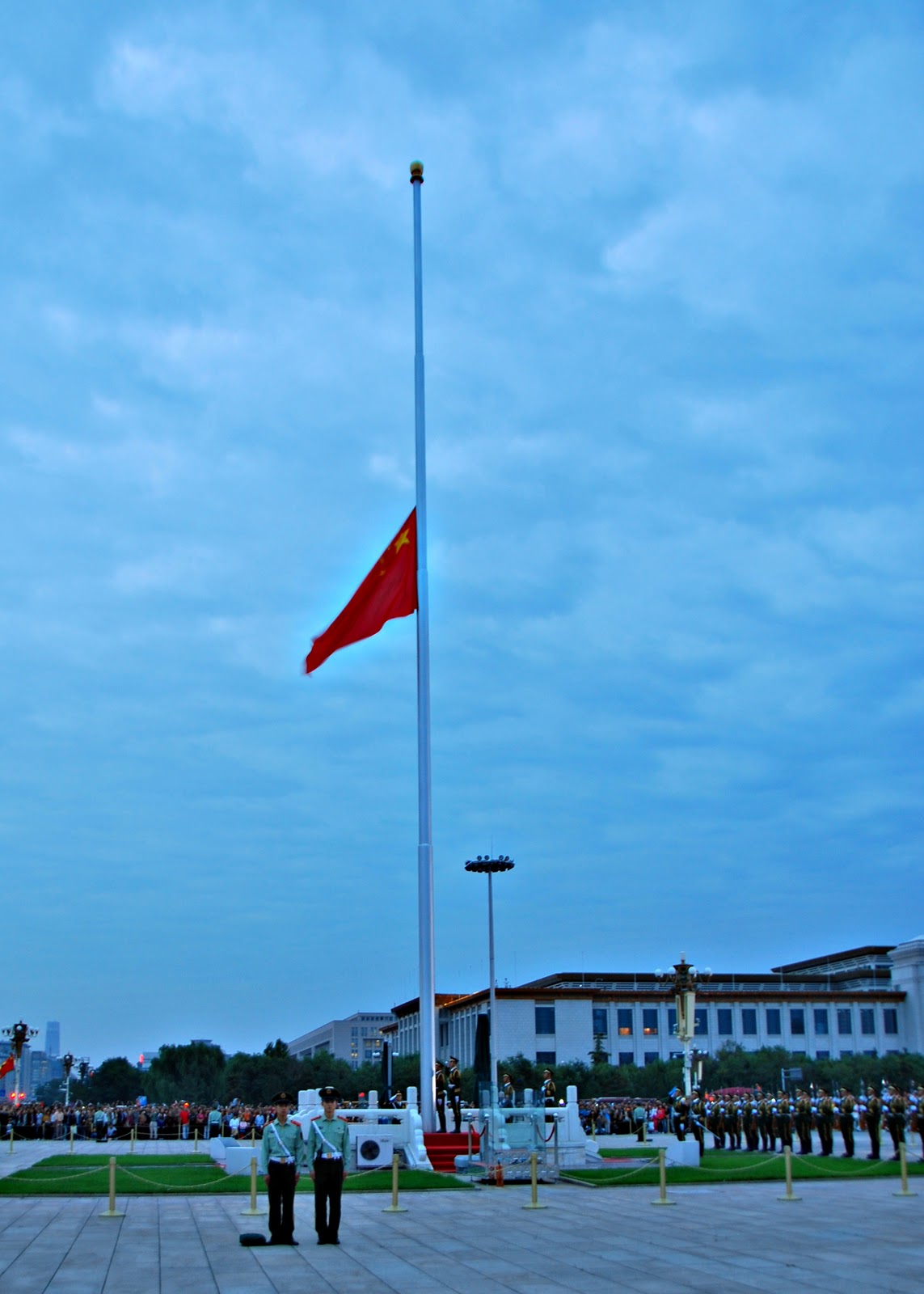
We witnessed the flag lowering at the Square at sundown of Sept. 19; it was past 6pm.  The daily flag raising and flag lowering is an event to see in Beijing. Many tourists and Chinese nationals come to see this.  

This nationalistic scene is quite unusual for a Pinoy; except for those working in government offices (who attend flag raising and lowering activities once a week), an ordinary Pinoy does not have an opportunity to witness the flag being raised and lowered daily. The Chinese do this daily, complete with snappy and very young (as young as 18years old) soldiers as honor guards.  The honor guards, in a formation, march from the Forbidden City, cross the street, and enter the Tian'anmen Square towards the flagpole.  The folding of the flag is even more interesting, kind of like watching Jet Li with his kung-fu moves in the movie Forbidden Kingdom.  

I was just a bit uncomfortable especially during the long waiting time for sundown (because the flag has to be lowered at sundown!), because my thoughts turned to the massacre of protesters that happened in the Square in 1989.

At the other side of the square, from the Forbidden City gate, is the Monument of People's Heroes and the Mausoleum of Chairman Mao Zedong.
Night view of Tian'anmen Square showing the Tian'anmen gate and the Monument for People's Heroes; railway station


Our final stop for the day was the Kung Fu Show.

Beijing China: FORBIDDEN CITY

Day 1 in Beijing: FORBIDDEN CITY 
(Destination 4 of 6)

Imperial Palaces of the Ming and Qing Dynasties in Beijing and Shenyang, as inscribed in the UNESCO World Heritage List in 1987.


The Forbidden City is home to the emperor and his family.  The place is divided into two parts: the outer court, where the ceremonies are held, and the inner palaces, the home of the emperor and his family.
"In ancient times, the emperor claimed to be the son of Heaven, and therefore Heaven’s supreme power was bestowed upon him. The emperors’ residence on earth was built as a replica of the Purple Palace where God was thought to live in Heaven. Such a divine place was certainly forbidden to ordinary people and that is why the Forbidden City is so named." (China Highlights)

I learned from our guide that both the outer court and inner palaces have three major structures. The structures in the outer court are the (1) Hall of Supreme Harmony, "the ceremonial centre of imperial power", where the emperor held ceremonies; (2) Hall of Central Harmony, where the emperor prepared and rested during ceremonies; and the (3) Hall of Preserving Harmony, where rehearsals were held.   

The inner palaces are the residences of the emperor and the empress.  The emperor stays in his residence alone because attempts on the life of the emperor had been made while asleep.
"The Emperor, representing Yang and the Heavens, would occupy the (1) Palace of Heavenly Purity. The Empress, representing Yin and the Earth, would occupy the (2) Palace of Earthly Tranquility. In between them was the (3) Hall of Union, where the Yin and Yang mixed to produce harmony." (Wikipedia)

It is more dramatic to enter from the gate leading first to the inner palaces then to the outer court because from smaller structures, one is led to the biggest and grandest structure of them all, the Hall of Supreme Harmony.  The courts also get bigger and bigger as one moves to the entrance/exit leading to Tian'anmen Square. 


The Chinese government approved the filming of the movie The Last Emperor, a story about the six-year old Puyi, the last emperor who was overthrown by the Chinese Communist, within the Forbidden City.  After being in Forbidden City, one will appreciate the movie even more.  And if one is imaginative enough, one can actually visualize the imperial life centuries ago. 


Our guide also told us these details:
Yellow is the imperial color.  Red signifies happiness.  Red and yellow are dominant on the structures in the place.

The roof of the buildings is decorated with animal statuettes, the number of which tells how important the building is.  The "animals" are in between a man riding a phoenix (front/leader) and an imperial dragon (rear).  In this picture, the animals total 9, which is the number representing the emperor.  The empress is represented by 7, the lower numbers 5, 3, 1 represent lower "status".
 
According to Wikipedia.com,"The Hall of Supreme Harmony has 10 (animal statuettes), the only building in the country to be permitted this in Imperial times. As a result, its 10th statuette, called a "Hangshi" is also unique in the Forbidden City."
  
The City is surrounded by a moat, for security reasons.  The ground excavated to make the moat is the artificial hill in Jingshan Park. 


Photos of other details in architecture and other artifacts -
1 Female lion fronting the empress's residence - the female lion has a cub under her left paw representing fertility (a male has a ball under his paw, representing power)
2 Incense burner near the Palace of Heavenly Purity
3 Turtle statue
4 Key still in the lock
5 View of the room inside the empress's palace
6 Door detail 
7 Bronze vat - in the past, this was kept full of water for extinguishing fires  
8 Door (Hall of Union)


Our next stop was Tian'anmen Square.

Beijing China: PEKING DUCK lunch

Day 1 in Beijing: PEKING DUCK LUNCH
(Destination 3 of 6)

A trip to Beijing wouldn't be complete without tasting the world famous Peking duck. We got our fix from Quanjude Roast Duck Restaurant, a famous brand of China, established in 1864, during the Qing Dynasty.   

The ducks are roasted from sweet-smelling fruit-wood. The menu boasts of an all-duck fare.  
"The finished duck is characterized with crispy skin, tender meat and the fragrance from the fruit-wood. It looks wonderful and appealing with a full figure, even claret color and the brightness and shine on the duck skin. It tastes pure and mellow with lotus leaf-shaped cake, scallion slices and sweet sauce jam, leaving a lasting and pleasant aftertaste." (Quanjude)

The duck skin was crispy and kind of like the world famous lechon in Cebu, Philippines.  We ate the meat by rolling it, together with cucumber and scallions, and sauce, in a wrap as thick as crepe.  It was very tasty and really good.  The side dishes are all made from duck.  


Duck fare: different ways to eat duck
To know more about how to eat Peking Duck in Beijing, refer to worldhum.com

Quanjude has many floors of duck restaurants, we went up to the 4th floor.  The restaurant was very pretty and picturesque and so colorful; it was a very happy place to eat.  After our meal, we got a commemoration card containing the code of the roast duck we ate (kind of weird, doesn't it?). 

Quanjude Restaurant

Wangfujing Street

After a very filling lunch, round the corner from the restaurant, a stroll along Wangfujing Street would be a healthy alternative...the fairly long street would take around 30minutes to walk from end to end.  Wangfujing is at the heart of the city, lined with shops, snack bars, bookstores.


Wangfujing Street

Next stop is Forbidden City.

Beijing China: TEMPLE OF HEAVEN

Day 1 in Beijing: TEMPLE OF HEAVEN
(Destination 2 of 6)


An Imperial Sacrificial Altar in Beijing, as inscribed on the UNESCO world heritage list.  According to UNESCO.org
"In its overall layout and that of its individual buildings, it symbolizes the relationship between earth and heaven – the human world and God's world – which stands at the heart of Chinese cosmogony, and also the special role played by the emperors within that relationship."
The majestic Temple of Heaven

The Temple was my third favorite place among the places we went to (first being the magnificent Great Wall and second the serene Summer Palace).  Even with lots of tourists milling around, the place was silent and still reverential.  From the entrance, one cannot help but stare in awe at the majestic Temple.  Repainted before the 2008 Olympics, the colors were so vibrant and alive on top of the (off) white stone base. 


Lamp stands and old paper money burners align the way to the Hall of Prayer for Good Harvests.  The temple was used only by the Emperor to offer sacrifice and pray to the god of heaven for good harvest during winter solstice.  It is said that his successful reign is dependent on the harvest of the season.  

Altar inside the temple
The temple design has the dragon and phoenix designs all over, then representing the emperor and empress, but now symbolizing husband and wife.  The color blue symbolized heaven.  

The dragon design is dominant all over the place, as shown in this water spout, at the base of the Temple.

Dragon & phoenix design
Dragon door knocker
Dragon water spout


The doors to the Temple have round gold designs (those are actually the nails), nine across and nine down.  The number 9 is the number of the emperor.  If you count the steps, they are also grouped by nine.  The door knocker also has the dragon design, symbolizing the emperor.  Yellow and red are considered imperial colors and are dominant throughout the imperial structures we saw in Beijing.

Copying a scene from Karate Kid 2
And on that particular day when we were scheduled to visit Temple of Heaven and Forbidden City, my husband wore yellow shirt, I wore red blouse and my son wore a red shirt with yellow print! Talk about imperial colors...what a coincidence!

Outside the Temple is an extensive park and garden with centuries-old trees lining the walkway and greens all around.  From a (home) city with no "green" public park, the place was really a refreshing sight. 


More photos...


(Left:) A centuries-old tree; (Middle:) My family, "where to go", lampposts
Our group


Next stop is our Peking duck lunch...

Be the first of your friends to like this...